Live events are controlled chaos.
Speakers change slides mid-sentence. Panelists interrupt each other. A remote presenter’s audio suddenly drops. The Wi-Fi that worked perfectly during rehearsal isn’t so perfect once 1,200 attendees log on.
And then it happens: the captions start lagging. Or worse - they stop working all together.
When live event captioning fails, it feels highly visible. Accessibility suffers, viewer confidence drops and social media notices.
But here’s the reality: captioning failures are rarely caused by one catastrophic breakdown. They’re usually the result of small, preventable gaps in planning.
The Myth: “The Technology Just Didn’t Work”
Modern real-time captioning technology, especially AI-powered ASR systems, is more accurate and resilient than ever. So when captions fall apart during a conference, webinar, or hybrid event, it’s often not the engine that failed.
It’s the ecosystem around it.
Live captions depend on a chain of inputs and decisions:
- - Audio routing
- - Production workflow
- - Terminology preparation
- - Multilingual handling
- - Distribution infrastructure
Break any link in that chain, and performance drops.
It Almost Always Starts with Audio
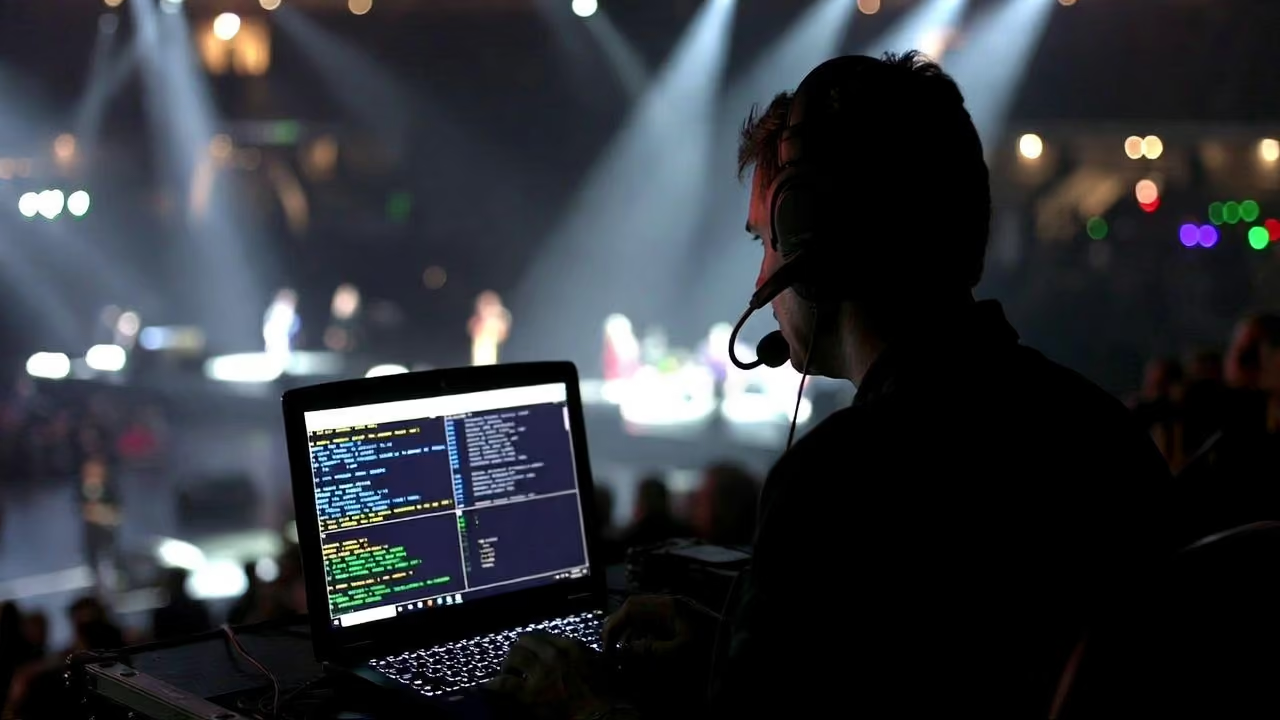
No captioning solution, whether human or AI, can transcribe what it cannot clearly hear.
In live environments, audio is often optimized for the in-room audience, not for transcription. A room mic might sound “fine” in the ballroom, but it carries echo and crosstalk that reduce live caption accuracy dramatically. Remote speakers might be routed differently than on-stage presenters. Panel discussions may overlap in unpredictable ways.
When captions struggle, the first place to look isn’t the software dashboard. It’s the soundboard.
Clean, direct audio feeds make more difference than switching vendors ever will.
Testing in Ideal Conditions Creates Real-World Failure
Many teams test captioning in a quiet control room or internal Zoom call and everything looks solid.
- But live events introduce friction:
- Rapid speaker transitions
- Hybrid audio mixing
- Streaming latency
- Concurrent users joining across networks
Caption systems that aren’t stress-tested under true production conditions can appear flawless until the event begins.
A full technical rehearsal that mirrors real-world load, platform routing, and multilingual streams is often the difference between smooth delivery and visible failure.
Terminology Should Not Be Optional
Industry events are dense with brand names, acronyms, product launches, and technical jargon. If your captioning system hasn’t been prepared with that context, accuracy will suffer - not because the technology is incapable, but because it wasn’t informed.
Providing speaker names, translation glossaries, and approved terminology dramatically improves real-time results.
The strongest live captioning workflows treat terminology like part of pre-production, not an afterthought.
Multilingual Adds Complexity - Not Just Translation
As global audiences grow, multilingual captioning is becoming standard. English to Japanese. Korean to English. Multiple simultaneous language feeds.
This isn’t simply about translating words. Tone, honorifics, pacing, and cultural nuance all matter — particularly in languages where formality changes meaning.
Without intentional prompt design and testing, translated captions may be technically accurate yet culturally off.
When multilingual workflows are built strategically — with tone guidance, concurrent capacity planning, and language-aware testing — they expand audience reach without introducing instability.
Access Friction Is a Silent Failure
Even perfectly accurate captions fail if attendees can’t access them instantly.
Requiring app downloads. Complicated logins. Captions limited to one screen. No mobile optimization.
In live environments, friction equals abandonment.
Frictionless delivery — such as browser-based access and QR entry — dramatically increases adoption and ensures captions are actually used.
Infrastructure Breaks Under Scale
What works for a 50-person webinar may not hold up for a 5,000-attendee hybrid conference.
Large events introduce:
- - Thousands of concurrent viewers
- - Multiple language streams
- - Cross-platform delivery
- - Variable network conditions
Scalable cloud infrastructure and real-time monitoring are not luxuries. They’re requirements.
Reliability under pressure is the real differentiator in live event captioning.
So Why Does Live Event Captioning Fail?
Because it’s often treated like a plug-in.
When captioning is added late in production planning, disconnected from audio engineering, ignored during rehearsal, or layered on top of multilingual strategy without testing, the cracks show — publicly.
When it’s integrated early — into audio routing, technical rehearsal, terminology preparation, multilingual design, and distribution planning — it becomes steady, even when everything else is moving.
How to Make Sure Yours Doesn’t
If you want your live captions to perform reliably:
- Start with clean audio.
- Test in real conditions.
- Prepare terminology in advance.
- Design multilingual workflows intentionally.
- Remove access friction.
- Confirm scalability before showtime.
Live event captioning should not be the element you worry about during your event.
It should be the part that simply works - supporting accessibility, engagement, compliance, and global reach without drawing attention to itself.
Because when captions are done right, no one notices them.
And that’s exactly the point.