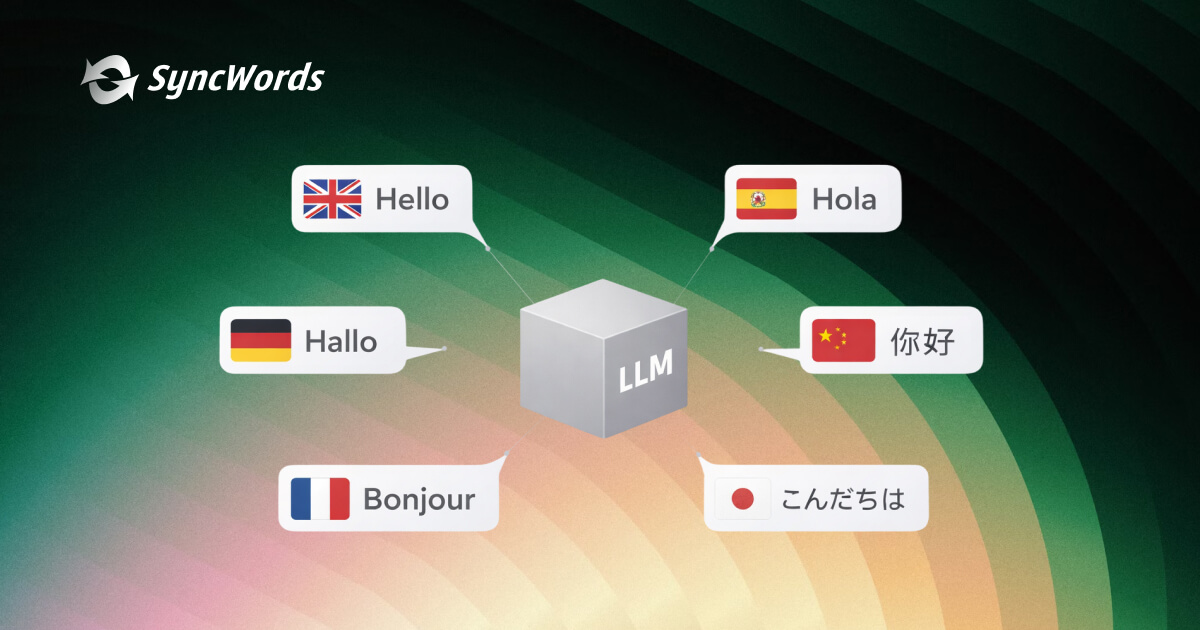
If you're already streaming live content to a global audience, there's a question worth sitting with for a moment:
Are you truly localizing your content…
or just translating words?
Because those two things feel very different to the viewer.
And in live streaming, where there's no rewind, no edit, no second chance…
that difference becomes everything.
The Hidden Gap in Live Translation
Most workflows today rely on a familiar chain:
Audio → Speech Recognition → Machine Translation → Subtitles or Audio
On paper, that sounds complete.
But have you ever noticed what happens when you actually watch it back?
- The words are correct… but the tone feels off
- The sentences are accurate… but too long to read in time
- The message is there… but the emotion is gone
So it raises a deeper question:
What's really missing?
The Shift: From Output to Guidance
What if the issue isn't the model…
…but the lack of guidance given to it?
Because most systems ask AI to translate…
But very few tell it how to translate.
This is where LLM prompting changes everything.
What Are "Extra Prompts" in Live Streaming?
Extra prompts are real-time instructions that guide how an LLM produces translation output.
Not just:
"Translate English to Spanish"
But:
"Translate English to Spanish using conversational tone, compress output for subtitles, preserve speaker intent, and adapt idioms for a Latin American audience."
They act as a control layer for:
- Tone
- Style
- Cultural alignment
- Grammar
- Output length
So instead of reacting…
The model starts behaving intentionally.
Why Extra Prompts Matter (Especially Live)
In a live stream, there's no editor.
No cleanup pass.
No second take.
So prompts effectively become your real-time editorial brain.
They directly influence:
Readability
Guiding shorter, clearer phrasing that fits subtitle constraints
Latency Perception
Reducing unnecessary verbosity so viewers keep up with the moment
Cultural Relevance
Adapting language to feel natural for the target audience
Grammatical Accuracy
Ensuring correct gender, tone, and structure for complex languages
Custom Subtitling Translation: The Constraint of Time
Live subtitles don't just need to be accurate.
They need to be readable in motion.
So the question becomes:
How do you fit meaning into time?
Example Prompt for Subtitles
"Translate into Brazilian Portuguese for live subtitles. Limit to 2 lines per segment, max 42 characters per line. Prioritize clarity over literal translation."
This ensures:
- Clean formatting
- Natural pacing
- Viewer comprehension
Themed Prompts: Matching Translation to Content
Not all content should sound the same.
And yet… most translation systems treat it that way.
News
"Maintain formal tone, concise phrasing, and factual accuracy"
Sports
"Use high energy, short phrases, and expressive commentary style"
Live Commerce
"Use persuasive, conversational tone focused on benefits"
Corporate
"Use professional, precise language with no ambiguity"
So let's ask the real question:
If the tone of your content changes… shouldn't the translation change with it?
Sports Commentary Is Culture — Not Just Language
If there's one place where this becomes obvious, it's sports.
Because sports commentary isn't just describing a game.
It's culture in motion.
A UK commentator sounds different from a U.S. one.
French broadcasts carry rhythm.
Italian commentary brings drama.
German delivery is precise and structured.
So what happens when you translate that literally?
You lose the feeling.
Example
Original:
"What a screamer! He smashed that into the top corner!"
A literal translation may be correct…
But will it feel like the local broadcast?
Using Prompts to Localize Sports Culture
With LLM prompts, you can guide translation to sound native.
UK Football
"Use British football commentary tone with familiar phrases and high energy"
Output:
- "What a strike!"
- "Top bins!"
French Football
"Use Ligue 1 broadcast tone with natural French cadence"
Output:
- "Quelle frappe exceptionnelle !"
- "En pleine lucarne !"
Italian Football
"Use expressive, passionate Serie A commentary style"
Output:
- "Che gol straordinario!"
German Football
"Use structured, precise Bundesliga-style commentary"
Output:
- "Was für ein Treffer!"
U.S. Sports
"Use energetic NBA/NFL-style phrasing with modern tone"
Output:
- "He throws it down!"
- "Are you kidding me?!"
The Real Opportunity: Micro-Localization
Now imagine going even further:
"Translate into Brazilian Portuguese using Flamengo fan-style commentary, high emotion, fast pacing, short subtitles"
Now you're not just translating…
You're entering the fan's world.
Compression: The Constraint You Can't Ignore
Live translation has another hidden challenge:
Languages expand.
English to German or Spanish can increase text length by 20–50%.
So what happens if you don't control for that?
- Subtitles overflow
- Timing drifts
- Viewers fall behind
Prompt-Based Compression
"Translate into French with 20% compression. Preserve meaning, remove filler words."
Example
Original:
"We're incredibly excited to bring you this amazing opportunity today."
Compressed:
"Nous sommes ravis de vous offrir cette opportunité aujourd'hui."
Cleaner. Faster. More readable.
From Text to Voice: Bringing Translation to Life
So now the translation is accurate.
It's localized.
It fits the screen.
But let's ask one more question:
Does it sound right?
The Missing Layer: Emotion
Subtitles are only part of the experience.
In live content, the voice carries:
- Energy
- Urgency
- Emotion
Prompt + TTS = Full Experience
When LLM output is paired with live dubbing technology:
- LLM Prompt → defines meaning and tone
- TTS → delivers emotion, pacing, and voice identity
Example Workflow
- Live speech is transcribed
- Prompt shapes translation
"Italian, passionate football tone, short phrases" - TTS renders with:
- Faster pacing
- Emotional delivery
- Natural cadence
The Result
Not just translation…
But a voice that feels like it belongs.
The Bigger Question
If your live translation today is:
- Accurate… but not engaging
- Fast… but hard to follow
- Scalable… but inconsistent
Then maybe the issue isn't the technology.
Maybe it's the instruction layer behind it.
Conclusion: Prompts Are the New Control Surface
You can't control:
- The speaker
- The pace
- The unpredictability of live content
But you can control how that content is experienced.
LLM prompts turn translation into:
- Intentional
- Context-aware
- Emotionally aligned
At SyncWords, we don't see prompts for translation as configuration.
We see them as a real-time storytelling layer—
ensuring that every viewer, in every language, doesn't just understand the content…
…but experiences it the way it was meant to be felt.