CEA-608 vs 708: what broadcast teams need to know
608 or 708? Most US chains carry both in one data stream. What each standard does, how 608 reaches a 708 decoder, and when neither belongs in your workflow.
Every caption RFP in North America asks for "608/708 support". Written like that, it sounds like two formats and a choice between them.
It rarely is. In most digital broadcast chains the two travel together, and the 608 data rides inside the 708 caption stream. The question worth asking is different: which device at the end of your chain reads which data, and what does each of your other destinations need instead?
This post answers that for broadcast engineers. For the wider picture (where captions can join a chain, WebVTT and TTML, how delay works), see the guide to live captioning for broadcast and streaming.
The short version
- 608 and 708 are not rivals. 708 is the digital TV caption standard, and its data stream carries 608 alongside it for compatibility.
- CEA-608 and EIA-608 are the same standard. The name followed the standards body. We write EIA-608.
- SyncWords writes EIA-608. A system that expects 708 receives our 608 inside the caption data. We do not generate native 708 services.
- Neither belongs in an HLS player chain or on a European set-top box. Those want WebVTT, Teletext or DVB-SUB.
608: the format that won't retire
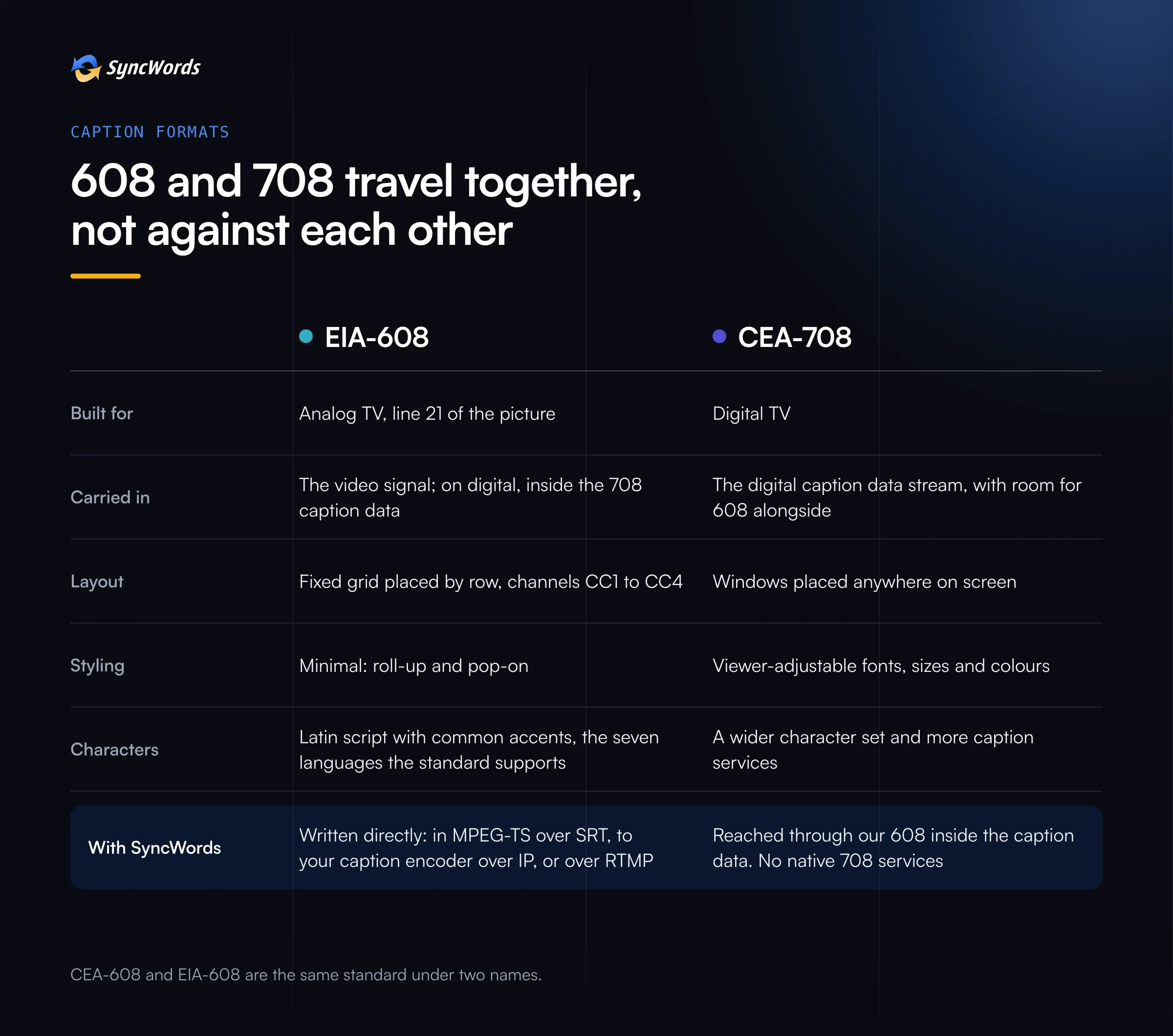
EIA-608 was designed for analog television, hidden in line 21 of the picture. Analog broadcasting is gone in North America; 608 is not. It survived because it moved inside the digital signal and because a huge base of equipment still reads it: playout servers, hardware caption encoders, transcoders, monitoring tools, and the caption logic in many players.
What it gives you is deliberately simple:
- Four caption channels, CC1 to CC4. CC1 is usually the primary language. Agree on the others before the broadcast so the Spanish track does not end up where a decoder expects English.
- A fixed grid. A few rows of text, placed by row number. Roll-up for live speech, pop-on for prepared content.
- A small character set. Latin script with common accents. It covers the seven languages the standard supports, including English, Spanish, French, Portuguese and Italian.
That simplicity is the point. Every box in the chain understands it.
708: the upgrade that still carries 608
CEA-708 is the caption standard for digital TV. It was built to fix what 608 could not do: more caption services, viewer-adjustable fonts, sizes and colours, multiple windows placed anywhere on screen, and a wider character set.
Here is what matters in practice. The 708 caption data stream has room for 608 bytes alongside the 708 services, so a single stream can serve old decoders and new ones. Many chains rely on exactly that: the caption source produces 608, it travels inside the digital caption data, and devices that want 708 find what they need there.
So "do you support 708?" usually means "will captions show up on a digital decoder?" For a 608 source carried in the digital stream, the answer is yes. If a specific downstream system insists on native 708 services with their own styling, that is a conversation to have with your engineers and ours before the broadcast, not during it.
How SyncWords handles 608
SyncWords writes EIA-608, and it reaches your chain in four ways:
- Embedded in MPEG-TS over SRT. Captions go back on your transport stream, before your transcoder. You choose the channel (CC1 to CC4), the number of lines, the row and the line length, so captions sit clear of lower thirds and score bugs. If your feed already carries 608, it can be passed through.
- Into your existing caption encoder. If you own a hardware caption encoder, SyncWords can drive it over IP (TCP, with TLS if you want it). Nothing is decommissioned on day one.
- Over RTMP to social platforms. YouTube Live and Facebook Live read 608 embedded in the RTMP stream.
- From your own captioners. If a human captioner or steno software already produces 608, SyncWords can take it in over a direct Control-A connection and build translated subtitles from it.
One thing we do not do: write HLS segments with embedded 608. If your HLS workflow genuinely needs 608, take it from us over SRT and run it through your own transcoder. For most HLS players, though, WebVTT is the better answer anyway.
Where neither 608 nor 708 belongs
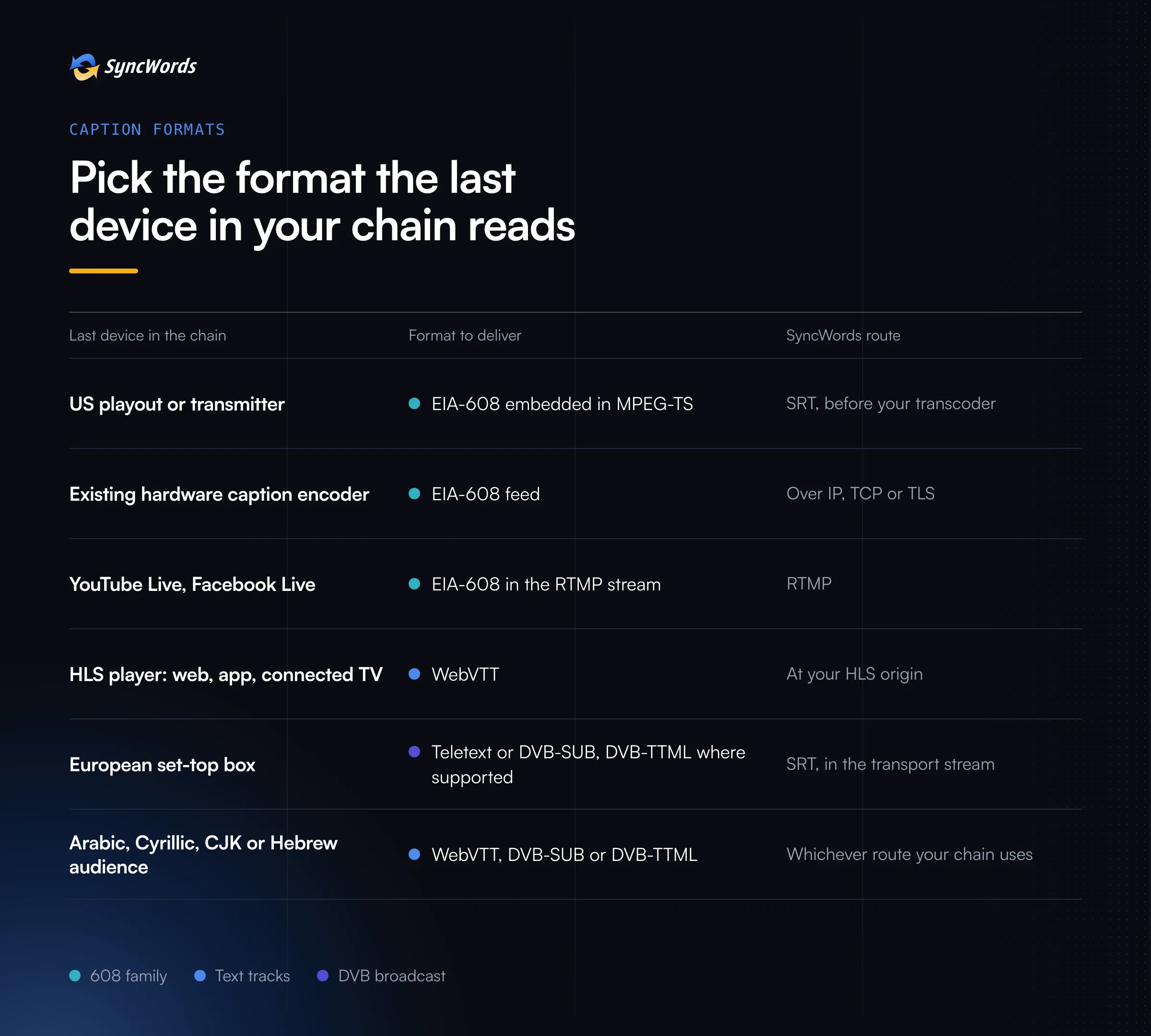
HLS players. Browsers, apps and connected TV players read WebVTT as a separate text track and show it in their own caption menu. It supports far richer styling and positioning than 608, and SyncWords can write it directly at your HLS origin.
European and DVB chains. 608 means nothing to most European set-top boxes. Teletext (DVB-TXT) is the most widely compatible option there, with a page number per language. DVB-SUB sends subtitles as bitmaps, so any decoder can show them. DVB-TTML is where the standard is heading, where your decoders support it.
Non-Latin scripts. 608 cannot carry Arabic, Cyrillic, Chinese, Japanese or Hebrew natively. A romanized version is technically possible, but it is rarely what an audience wants. Use WebVTT on the streaming side, and DVB-SUB or DVB-TTML on the broadcast side.
The rule from the pillar guide holds: match the format to the last device that has to read it.
What to settle in your next workflow review
- Which device reads the captions last? Playout server, transmitter, set-top box, player, or a social platform. Name it for each output.
- Who owns CC1 to CC4? Write down which language or service sits on which channel.
- Do your transcoders keep caption data? Some settings strip or rewrite it. Test the actual output, not the input.
- Does any system insist on native 708 styling? If so, raise it early.
- Do captions clash with graphics? Set the row and line count before the first show.
Captioning output is built to the FCC Title V criteria for accuracy, synchrony, completeness and placement, and it helps you meet the obligations that apply to your station. Compliance itself rests with the broadcaster; our output is built to support it.
Bring your chain diagram
Send us a sketch of your chain and we will tell you which format each destination needs, and whether 608 alone covers it.
Can't make it? Book a demo
Match every destination to the right caption format
Book a Demo