What We Heard at IBC 2026: Live Translation Is Moving Into the Workflow
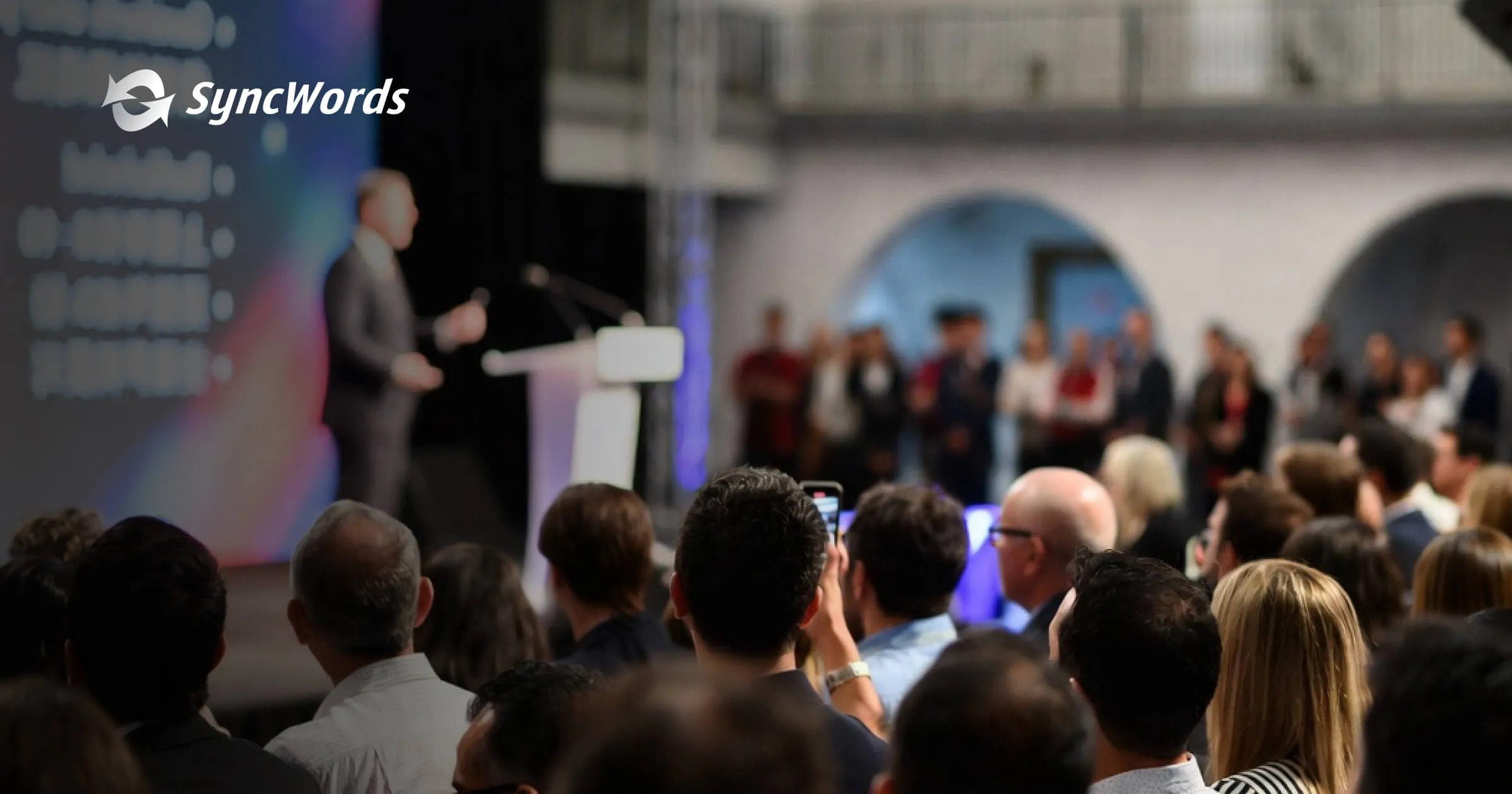
More than 400 visitors from over 300 organizations stopped by our booth in Hall 14. The questions had changed: less "can AI do this?" and more "how does it fit our workflow?"
IBC 2026 brought together broadcasters, streaming platforms, sports organizations, technology providers, systems integrators and media companies from around the world. For SyncWords, it was also an opportunity to have hundreds of conversations about where live captioning, translation and dubbing are heading next.
More than 400 visitors from over 300 organizations stopped by the SyncWords booth in Hall 14, the Future Tech Zone. That location attracted many people who were specifically interested in emerging AI technologies, and gave us plenty of opportunities to demonstrate what is possible today.
But the most interesting part wasn't simply showing what AI can do. It was hearing what organizations are trying to do with it.
The conversation is shifting from "Can it work?" to "How do we make it work?"
Across our conversations at IBC, there was strong interest in using AI to make live content available to audiences in more languages.
We spoke with broadcasters looking at translating existing live workflows, sports organizations exploring multilingual coverage, streaming platforms considering new localization opportunities, and technology companies looking to integrate translation into their own solutions. The use cases ranged from live subtitles and captions to translated audio and dubbing.
What stood out was that many of these conversations quickly moved beyond the question of whether AI translation was possible. The questions were much more practical:
- How does it fit into the workflow?
- What is the latency?
- How accurate is it?
- How does it work with the infrastructure already in place?
- And, perhaps most importantly, can it perform reliably when the content is live?
Those are very different questions from simply asking whether AI can translate a piece of content.
Live dubbing is becoming part of the conversation
Live audio translation and dubbing generated significant interest at IBC.
At the SyncWords booth, we demonstrated live captions, subtitles and translated audio, giving visitors the opportunity to see and hear the complete workflow rather than simply discussing the technology.
The conversations we had reflected growing interest in live dubbing across sports, news, events and broadcast applications. We also encountered organizations interested in testing specific language combinations and low-latency workflows with their own content.
For content owners, the potential is significant: instead of limiting a live program to the language in which it was produced, translated audio can open the door to audiences in other markets while the event is still happening.
That makes live translation less of a post-production exercise and more of a distribution capability.
Integration matters as much as the AI
Another consistent theme was that organizations aren't looking to replace their entire broadcast infrastructure simply to introduce AI translation. They want translation to work with the systems and workflows they already use.
At IBC, we had conversations around SRT, DVB-TTML, MediaConnect, timed transcript formats and other existing workflows. Several organizations were interested in testing SyncWords within their current infrastructure rather than creating a separate workflow around it.
This is an important distinction. The technology needs to fit into the production environment, not force the production environment to change around it.
Latency and reliability still matter
AI can produce impressive results, but live production has a different standard from a technology demonstration.
A few extra seconds may be acceptable in some applications and problematic in others. Accuracy that looks good in a controlled demo still needs to hold up with real presenters, multiple speakers, accents, fast-moving sports commentary and unpredictable live content.
Latency and accuracy came up repeatedly in conversations around potential proofs of concept, particularly for sports and other live applications.
That's why we continue to see value in testing with real content. A proof of concept isn't just an opportunity to demonstrate the technology. It allows a production team to see how translation performs within its own workflow, with its own content, languages, latency requirements and distribution environment.
Accessibility is becoming part of the AI conversation
Translation wasn't the only area where we saw interest in AI-powered accessibility.
At IBC, SyncWords demonstrated live AI-generated ASL and BSL through our integration with Signapse. We also had conversations around other sign-language applications, including French Sign Language and sign-language avatars.
This reflects a broader opportunity for AI to help make live content accessible to audiences who have traditionally been underserved by conventional production workflows.
Captioning, translation, dubbing and sign-language interpretation can increasingly be considered together as part of a broader accessibility and audience-reach strategy.
The global nature of the opportunity was impossible to miss
Perhaps one of the clearest takeaways from IBC was just how international the demand for live translation has become.
Our conversations touched on markets and language combinations across Europe, the Middle East, Asia, Africa and Latin America. We discussed everything from Italian broadcasters looking to translate into additional languages to sports applications involving Spanish, Arabic, Japanese, Estonian, Latvian, Portuguese and other languages.
For content producers and distributors, this points to an important shift. Multilingual content is no longer necessarily something that has to wait until after a live event or broadcast has finished. Increasingly, organizations are exploring how to reach international audiences while the content is still live.
From technology demonstration to real-world testing
One of the most encouraging aspects of IBC was the number of conversations that moved toward practical next steps.
We heard from organizations interested in proofs of concept, workflow testing and evaluating SyncWords with their own live content. That's where we believe the next stage of the conversation needs to happen.
Seeing a live translation demo is useful. Seeing how it performs on your own content, through your own workflow, for your own audience is much more meaningful.
What comes next?
IBC 2026 reinforced something we've been seeing across the market: live translation is moving from an emerging AI capability toward a practical part of the live content workflow.
The technology continues to evolve, but the questions from broadcasters, sports organizations, streaming platforms and content providers are becoming increasingly concrete.
- How can we reach more audiences?
- How can we make live content accessible in more languages?
- How can we add translated audio without disrupting the existing production workflow?
- And how can we do all of that while maintaining the latency, quality and reliability that live audiences expect?
Those are the conversations we're looking forward to continuing after IBC.
If you're exploring live captioning, translation or dubbing and would like to see how SyncWords works with your own content and workflow, we'd be happy to continue the conversation.
See live translation run on your own content and workflow
Book a demo